What is SkillFlaw?
SkillFlaw is a third-generation enterprise agent platform oriented toward business execution and enterprise digital employees. Its purpose is not simply to attach more tools to AI, but to organize enterprise business expression, business skills, business-system access agents, and digital-employee authorization into one governed platform so that intelligent capability can be developed, upgraded, operated, and delivered around business itself.
Build and run your first flow in minutes: Install SkillFlaw, and then try the Quickstart.
Platform positioning
SkillFlaw is defined in the context of a three-generation evolution of enterprise agent platforms. It does not treat workflow orchestration as the final product outcome. Instead, it puts business expression, skillized business knowledge, digital-employee authorization, and business-system access agents at the center of the platform model.
From a platform perspective, SkillFlaw is designed to:
- organize intelligent capability around business processes rather than around isolated tools
- use
SKILLas the standard carrier for expressing, upgrading, and governing business capability - let digital employees execute business work inside a unified boundary of identity, authorization, and governance
- connect enterprise business systems, knowledge, tools, and AI coding capability into one delivery loop
Three generations of enterprise agent platforms
SkillFlaw's product definition comes from the evolution of enterprise agent platforms from intelligence-oriented systems, to intelligent automation, and finally to business-oriented digital-employee platforms.
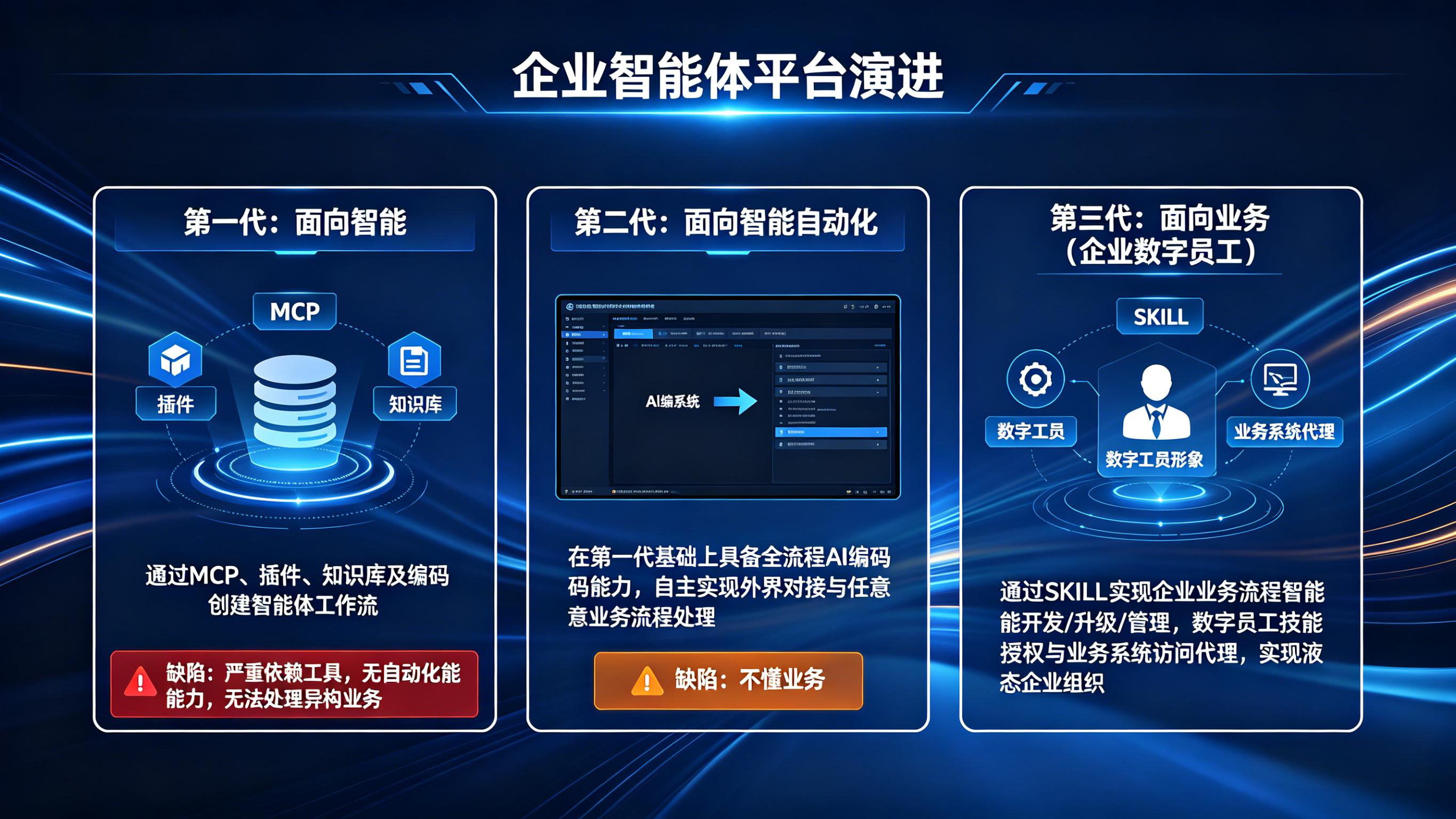
First generation: intelligence-oriented
In the first half of 2025, the team completed a first-generation enterprise agent platform. That generation focused on MCP, plugins, knowledge bases, and code-created agent workflows. Its main question was how to connect external tools, knowledge, and model capabilities into AI workflows quickly.
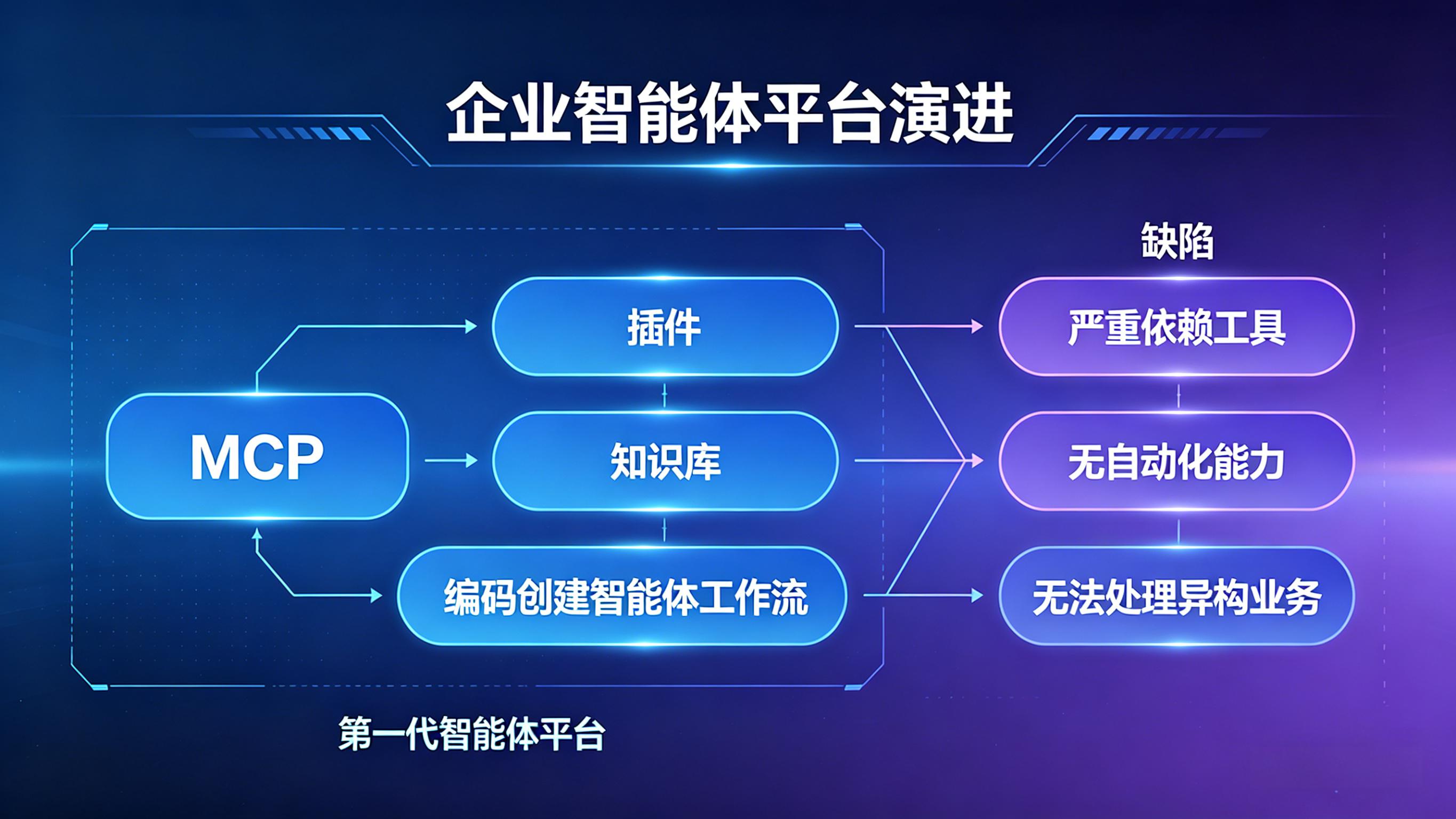
The first generation brought clear strengths:
- rapid assembly of agent workflows through MCP, plugins, knowledge bases, and code
- strong support for model experimentation, tool integration, and knowledge-augmented prototypes
- a practical way to validate intelligent capabilities early
It also exposed equally clear limitations:
- it depended heavily on external tools and knowledge assets
- it lacked true automation capability at the business-execution level
- it could not handle heterogeneous enterprise business processes reliably
Second generation: intelligent automation-oriented
To address the limitations of the first generation, the platform direction shifted toward automation. On top of the first-generation foundation, the second generation introduced full workflow coding capability for AI and evolved into a component-oriented development platform. It attempted to use AI Code to replace the traditional RPA implementation path built around rule engines and low-code platforms, while also covering intelligent automation scenarios that RPA struggles to address, including coding, document and image processing, complex content transformation, and cross-system orchestration.
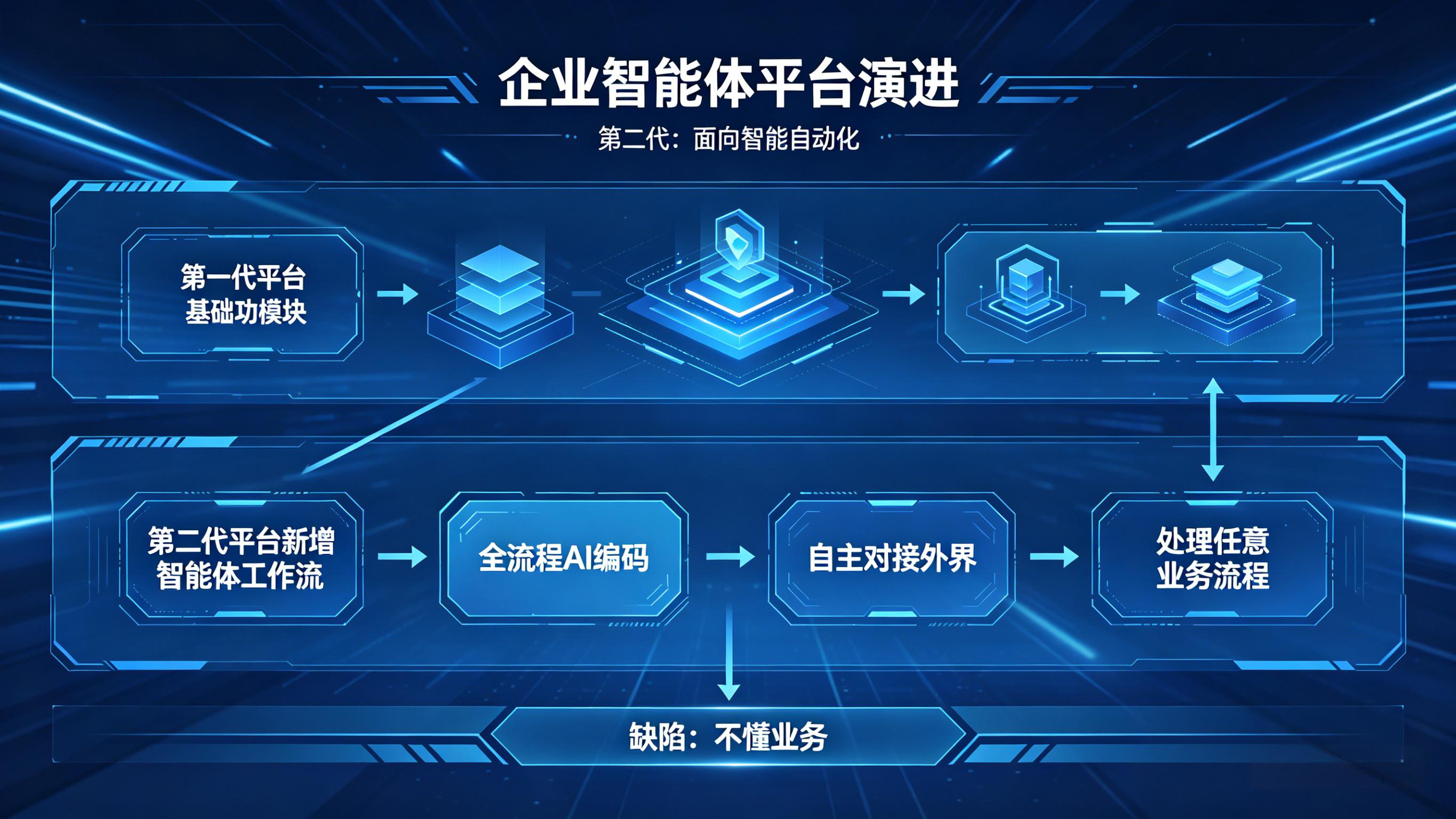
The second generation improved the platform in several ways:
- it established full workflow coding capability for AI-driven delivery
- it evolved into a development platform organized around reusable and extensible components
- it made it possible to handle more complex automation tasks and cross-system business flows through AI Code
However, the second generation still had a decisive boundary: although it had gained much stronger automation and coding capability, it still lacked a standardized way to express business itself. It could orchestrate processes, connect systems, and execute tasks, but it still could not turn enterprise business into a core object that could be defined in a standardized way, governed consistently, and upgraded continuously.
Third generation: business-oriented and digital-employee-oriented
By the end of 2025, SKILL had emerged as a standard way to express business capability, and the release of Opus 4.5 pushed AI coding capability to a new threshold, making the path from business -> SKILL -> code realistically achievable.
At the same time, products such as OpenClaw and Harness Agent accelerated the practical landing of both personal and enterprise digital employees.
SkillFlaw is defined under that background as a third-generation enterprise agent platform.
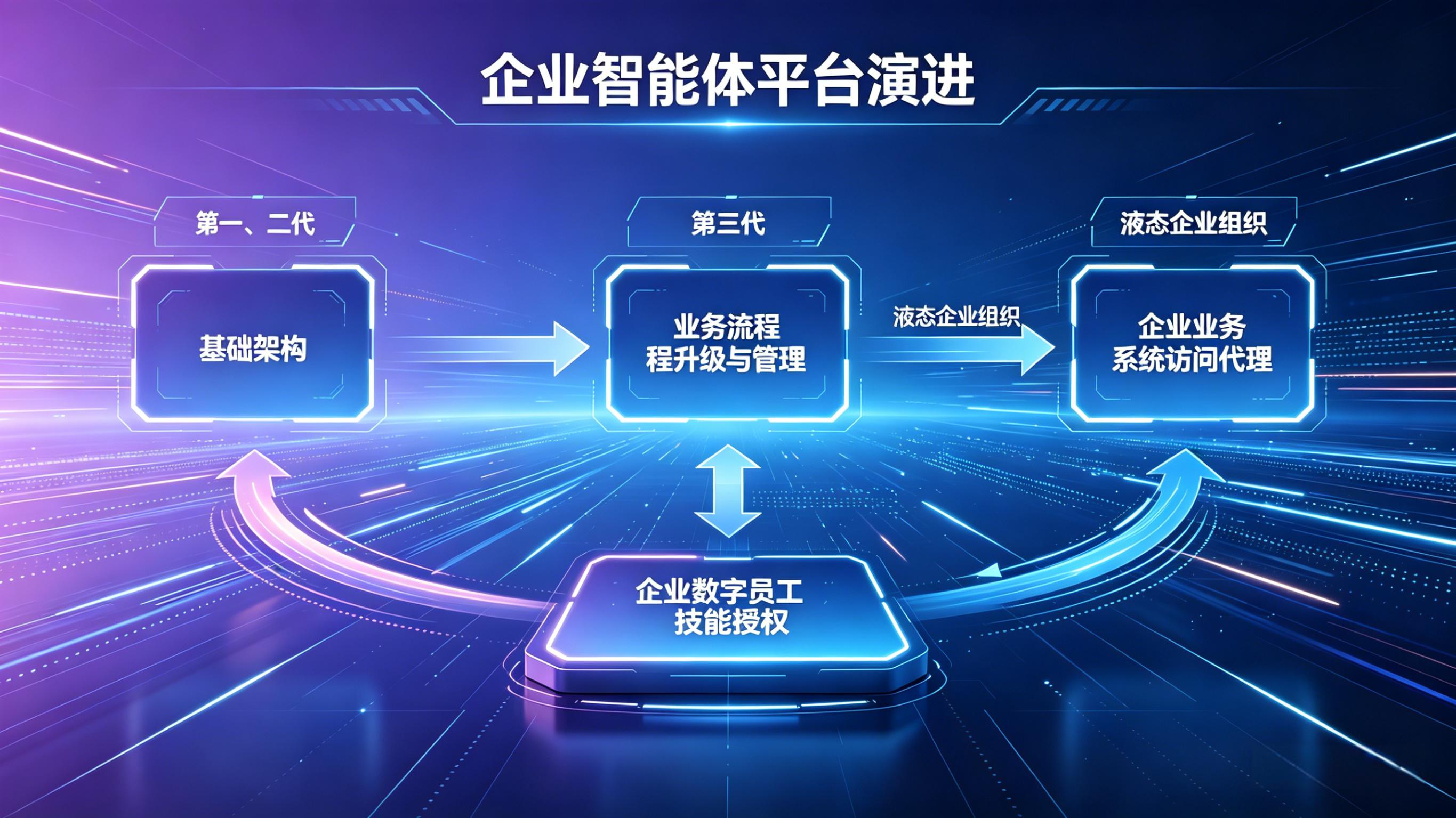
This generation emphasizes three things:
- business orientation: the platform organizes business processes, business rules, business upgrades, and business governance around enterprise business itself
- enterprise digital employees: digital employees, digital tools, business-system access agents, and skill authorization are assembled into governed execution units
- liquid organization: enterprises can dynamically organize digital employees and business collaboration around skill authorization and business access agents
How SkillFlaw integrates with enterprise business
SkillFlaw does not integrate with the enterprise by calling a single tool. It integrates enterprise business processes, enterprise systems, AI coding capability, employees, and digital colleagues into one platform boundary.
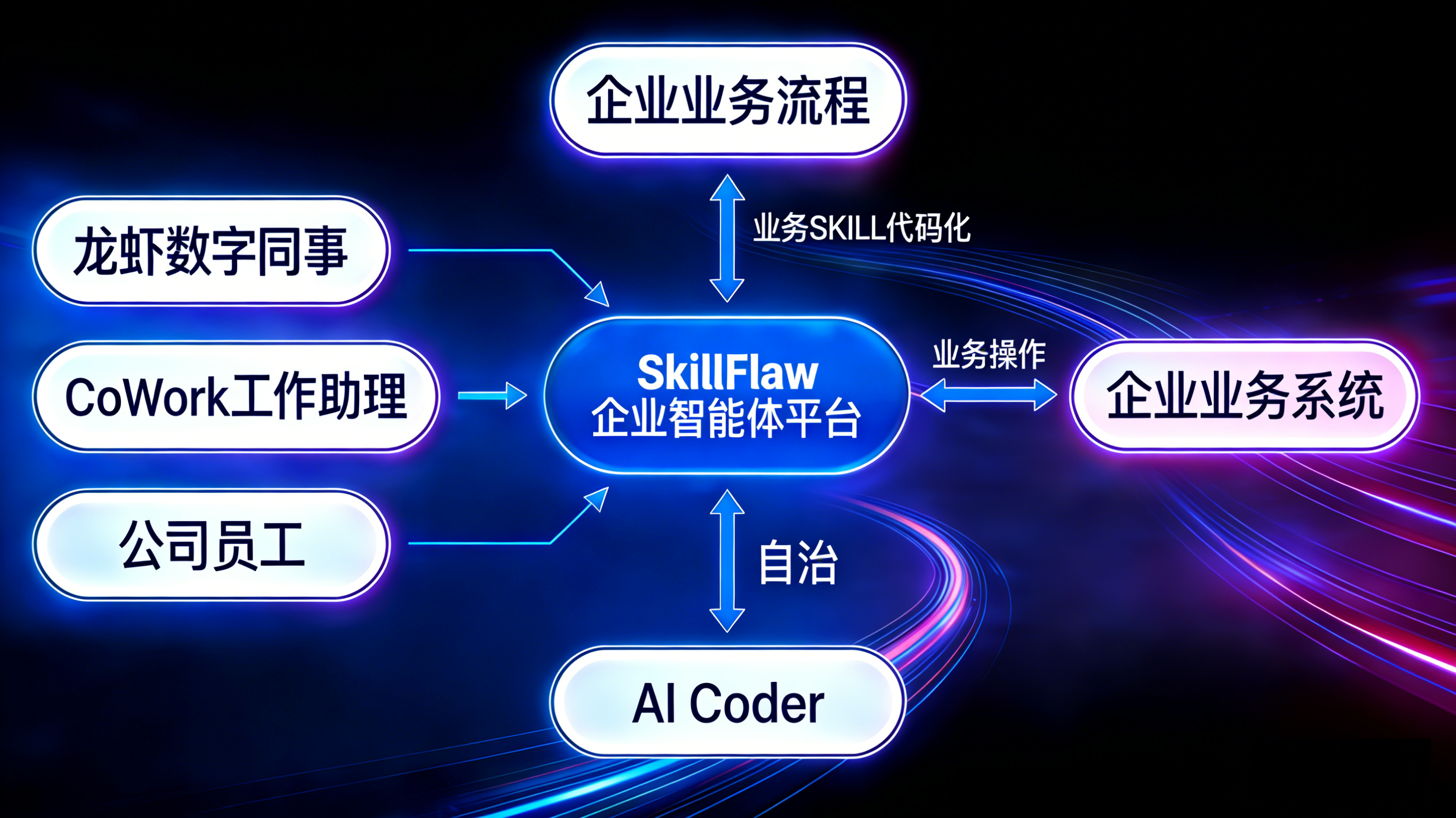
In this model:
- enterprise business processes can be expressed, upgraded, and code-generated through business
SKILL - enterprise systems are connected through governed business-system access agents
- employees, digital colleagues, and AI coders can collaborate inside one controlled platform boundary
- the platform supports both human participation and autonomous execution by digital employees
Target state of the third generation
The goal of SkillFlaw is not only to move existing workflows into an AI platform, but to give the enterprise a continuously upgradeable system of business expression and digital employees.
From an enterprise operating perspective, the target state includes:
- business processes that can be upgraded, governed, and reused continuously
- digital employees that can assume explicit business responsibilities under a unified authorization model
- business-system access agents that extend digital employees into formal enterprise systems
- an enterprise that evolves toward a liquid organization built around skill authorization and governed access
Product definition
Taken together, SkillFlaw can be defined as:
a third-generation enterprise agent platform centered on business
SKILLas the standard expression of capability, enterprise digital employees as the governed execution subject, business-system access agents as the integration boundary, and liquid organization as the target operating form.
It covers more than workflow orchestration. Its scope includes:
- management: authentication, tenancy, organization, user, business domain, settings, permissions, and configuration
- resources: models, components, knowledge bases, MCP services, OpenAPI plugins, and variables
- business: projects, workflows, workflow templates, enterprise integration, and digital-employee-facing delivery capability
- skills: skills, my skills, skill audit, and business-skill governance
These capability groups are explained in more detail in the Product architecture and Permission model pages.
Why SkillFlaw
The key difference of SkillFlaw is not that it supports more tools, but that it moves the center of the enterprise agent platform from tools and automation alone to business itself and the collaboration model around digital employees.
That means the platform is not only for:
- building workflows
- connecting models
- invoking tools
It is also for:
- expressing enterprise business as
SKILL - letting digital employees take on business execution under explicit authorization
- using business-system access agents to connect formal enterprise systems
- continuously upgrading enterprise business processes and organizational collaboration through a governed platform