Product architecture
SkillFlaw's product architecture serves its position as a third-generation enterprise agent platform oriented toward business execution and enterprise digital employees. It does not simply stack models, tools, and automation together. Instead, it organizes governance, reusable resources, business delivery capability, digital-employee execution capability, and runtime infrastructure into one unified platform.
From a formal product perspective, the architecture can be understood through four complementary views:
- platform capability layering: how the platform is built from governance, resources, business delivery, and skillized digital-employee execution
- enterprise business integration: how the platform connects enterprise systems, business skills, and governed digital employees
- business object relationships: how business objects, resource objects, and the authorization support system remain consistently connected
- technical implementation: how frontend, backend, runtime services, and documentation are delivered as one system
Business architecture
SkillFlaw uses a stable layered architecture to carry governance, reusable resources, business delivery, and digital-employee operations.
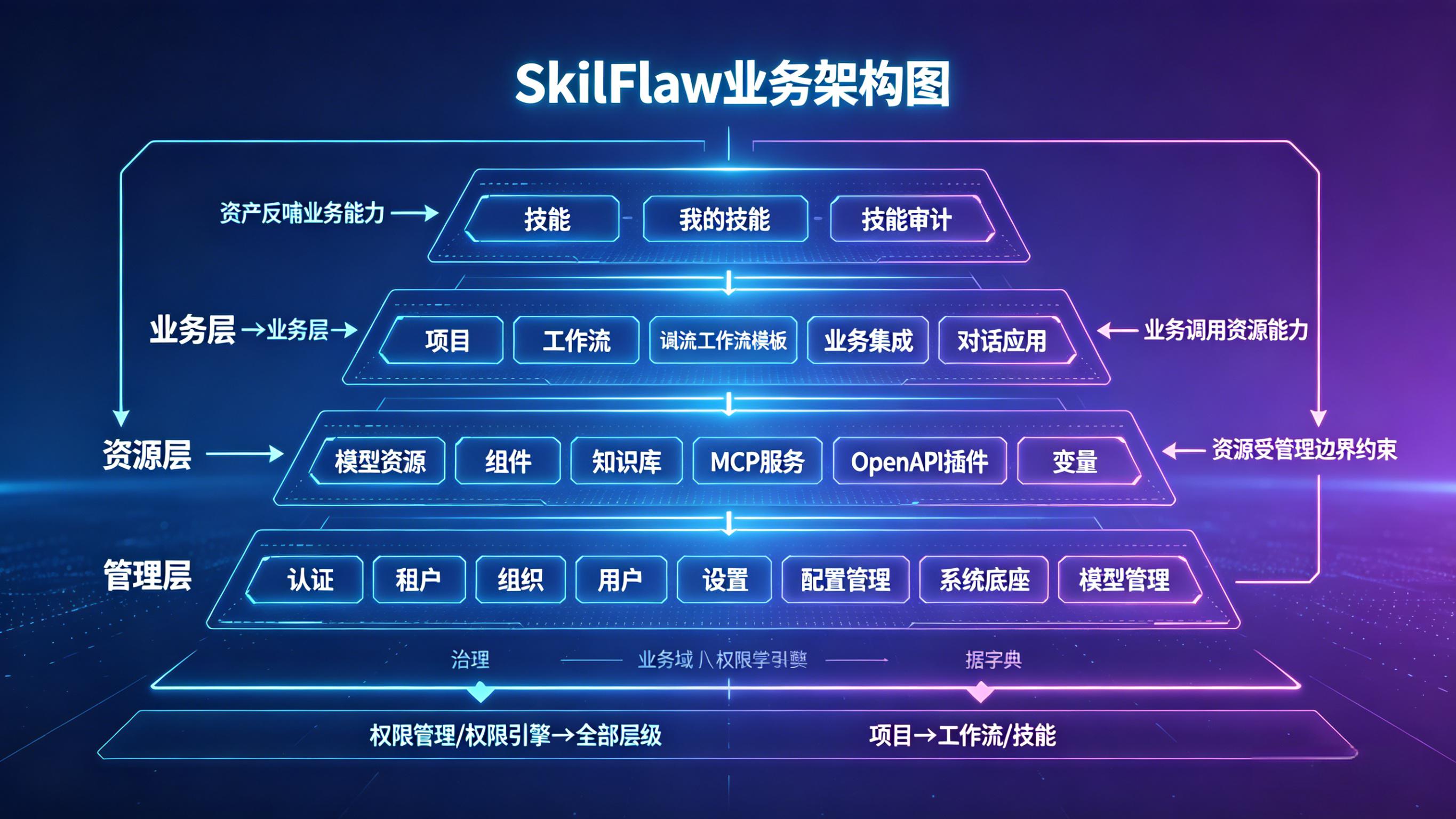
Management layer
The management layer provides the unified governance foundation for the platform. It covers:
- user identity and authentication
- tenant, organization, and business-domain boundaries
- permissions, authorization, and access-control rules
- platform configuration, dictionaries, and shared governance capabilities
This layer ensures that digital employees, reusable resources, and business-facing capabilities all operate inside stable identity, boundary, and governance rules.
Resource layer
The resource layer accumulates reusable AI and system resources such as models, components, knowledge bases, MCP services, OpenAPI plugins, and variables.
This layer answers the question of what reusable capability the enterprise can govern and reuse. Before resources can be consumed by business-facing capabilities, they are constrained by consistent visibility, access-type, ownership, and authorization rules.
Business layer
The business layer assembles resources into executable, maintainable, and deliverable business capabilities.
At this layer, enterprises organize projects, workflows, integrations, and conversational applications into real business solutions. This is where reusable resources become formal delivery capability.
Skill layer
The skill layer packages business capability into publishable, auditable, governable, and reusable skill assets.
Under the third-generation platform model, a skill is not an isolated script. It is the standard carrier for business expression, business upgrades, and digital-employee execution. Skills inherit the platform's tenant, business, visibility, and authorization rules and become one of the core execution units for enterprise digital employees.
Enterprise business integration architecture
Beyond capability layering, SkillFlaw must also solve how enterprise business is connected into the platform and turned into governed digital-employee execution capability.
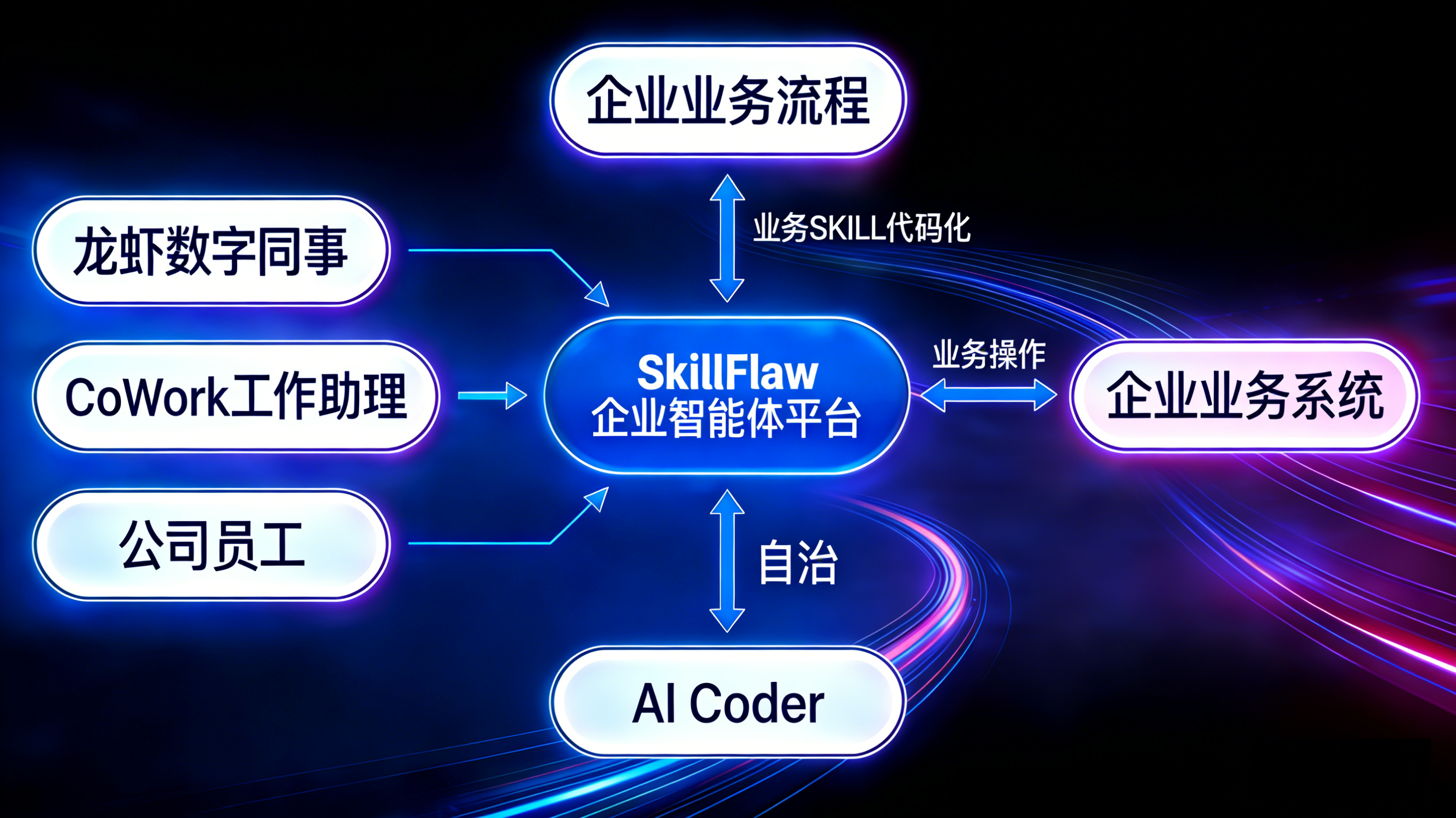
From the integration perspective, the architecture focuses on four things:
- standardized business expression: business processes, rules, knowledge, and operating actions are turned into governable business expressions
- digital-employee capability assembly: skills, tools, system-access agents, and authorization relationships are combined into governed execution units
- enterprise system connectivity: internal and external business systems, data sources, knowledge, and automation capability are brought into one collaboration framework
- continuous upgrade and governance: business capability can be developed, released, audited, and optimized continuously inside one platform
This is why SkillFlaw is not only about whether a model can be called. It is about whether business capability can be accumulated, operated, and upgraded continuously inside enterprise boundaries.
Business object relationships
The business object relationship view explains how business objects, resource objects, skill objects, and the governance support system connect through ownership, binding, publication, runtime execution, and authorization.
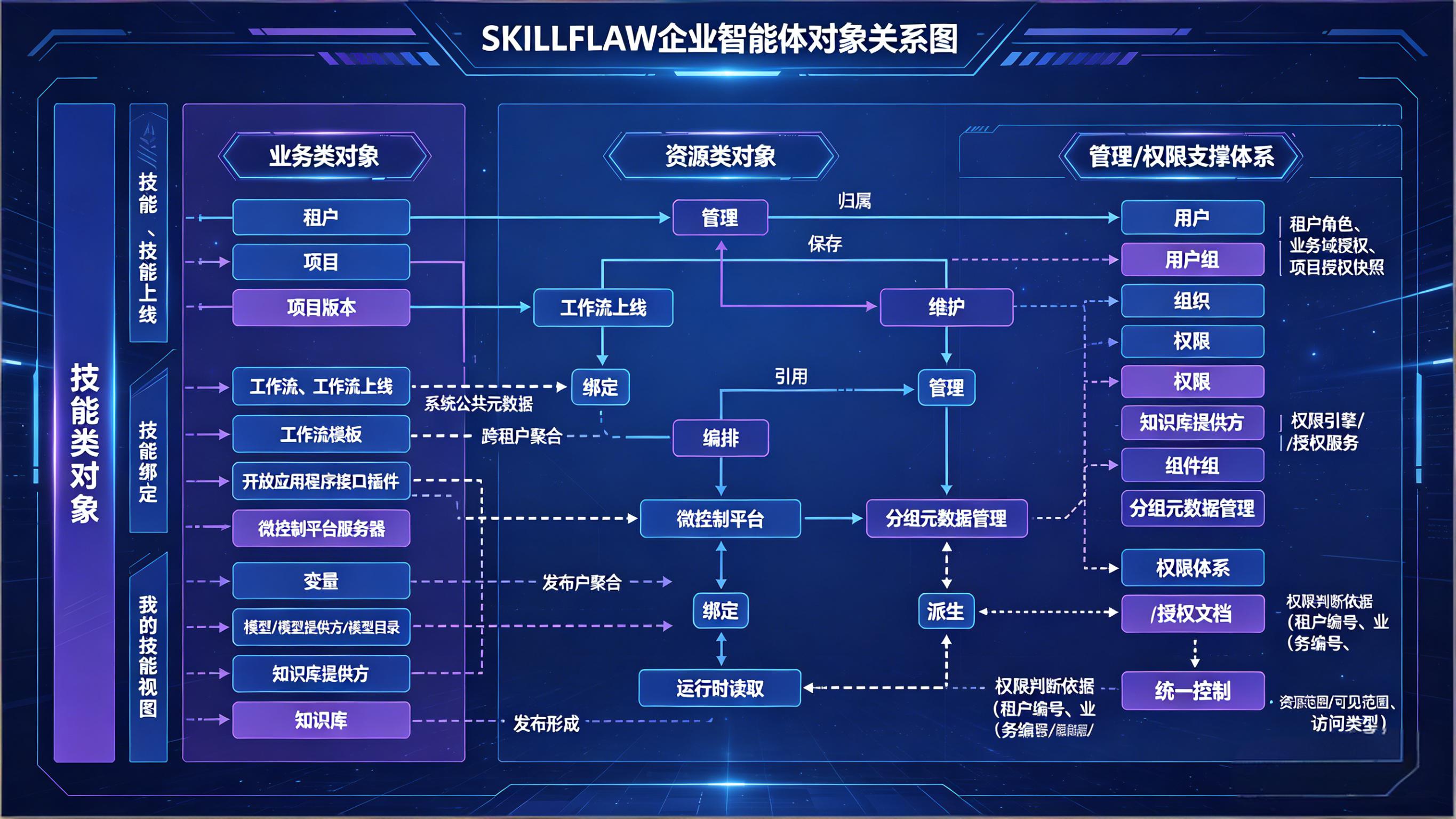
In the product model, these relationships fall into three stable groups:
- business object chains organize projects, versions, workflows, and online results into a full business-delivery path from design to publication
- resource object chains organize reusable assets such as models, components, knowledge bases, system connections, and variables into the capability base for delivery
- governance support chains organize users, organizations, permissions, authorization, and visibility boundaries into a unified decision basis for all platform objects
Technical architecture
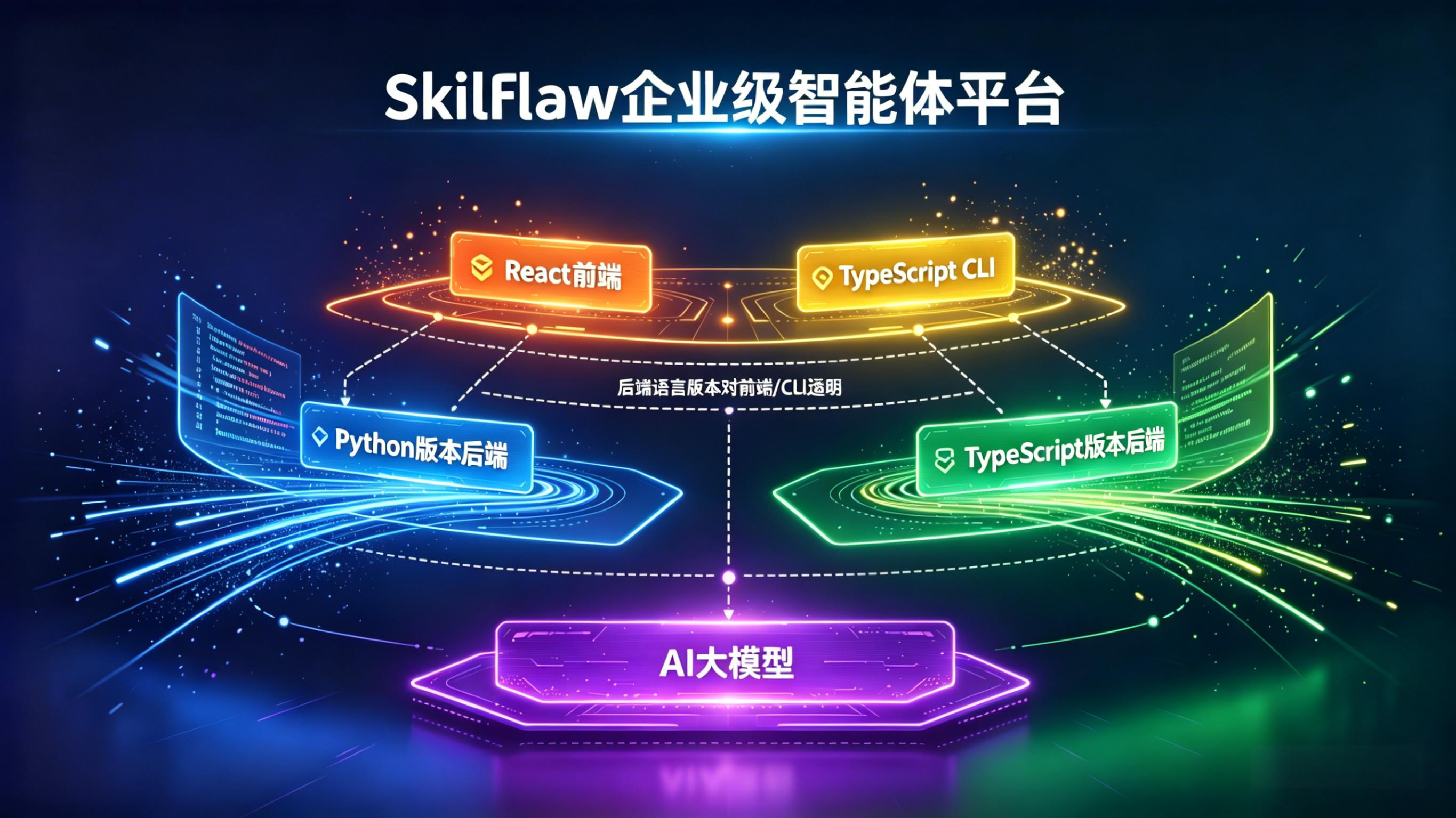
SkillFlaw's technical architecture supports unified product delivery through a frontend experience layer, backend service layer, data and runtime services, and an independent documentation capability.
Frontend experience layer
The frontend experience layer provides visual editing, management consoles, runtime interaction, and multilingual presentation. It delivers:
- management and governance entry points
- visual workflow and skill design experiences
- business delivery and runtime interaction interfaces
- a consistent bilingual product and documentation experience
Backend service layer
The backend service layer provides unified APIs, authorization control, business orchestration, resource scheduling, persistence handling, and runtime execution.
This layer is the central carrier of platform governance rules and business execution rules, translating user operations into stable, traceable, and auditable system behavior.
Data and runtime services
Data and runtime services provide the foundation of the entire platform, including:
- relational data storage for configuration, tenancy, organization, authorization, business data, and resource metadata
- cache and runtime support services for sessions, caching, and high-frequency access scenarios
- frontend and backend runtime containers that together form the complete product delivery environment
This layer ensures stable data and execution support for governance, resource reuse, business delivery, and digital-employee runtime activity.
Documentation runtime
The documentation site runs as an independent service and carries product overviews, manuals, developer guides, deployment guidance, and API reference materials.
In the current architecture, the documentation site is mounted at /, while the OpenAPI reference is exposed through /api, forming a formal documentation system delivered together with the product itself.
How the layers work together
At the overall platform level, SkillFlaw evolves capability along the path of governance -> resources -> business -> skills and digital employees -> runtime delivery.
The layers operate as follows:
- the management layer establishes identity, boundary, authorization, and governance rules
- the resource layer accumulates reusable AI and system capability
- the business layer assembles those resources into deliverable business solutions
- the skill layer packages business capability into governed assets that digital employees can invoke
- the runtime system ensures those capabilities can operate, evolve, and be governed continuously
This is the core architectural distinction between SkillFlaw and earlier generations of enterprise agent platforms: the platform no longer stops at tool connectivity or intelligent automation alone. It organizes enterprise business, enterprise digital employees, and platform governance into one coherent architecture.